Recovery-Aware LPB for RMP-Induced OOD States
A policy bridge that detects states created by reactive safety interventions and returns the robot to task-relevant behavior.
Problem
Reactive safety layers such as RMPflow keep a manipulator away from obstacles, but the avoidance motion can leave the robot in states that never appeared in the demonstrations. A diffusion policy queried from such a state has no reliable reference to return to, so a single safe intervention can turn into a task failure. The question was whether a latent-guidance method, Latent Policy Barrier (LPB), could be made aware of these avoidance-induced states without retraining the base policy.
Key result
91.3% — Recovery-aware LPB. 146 successes in 160 trials of the proposed method across eight OOD start configurations.
Contribution
I designed the recovery bridge and evaluated the proposed method in 160 RB10 trials. It completed 146 trials (91.3%); the original LPB reached 64.4% under the same intervention setting.
My Role
- Designed the recovery-state definition and recovery-aware policy bridge.
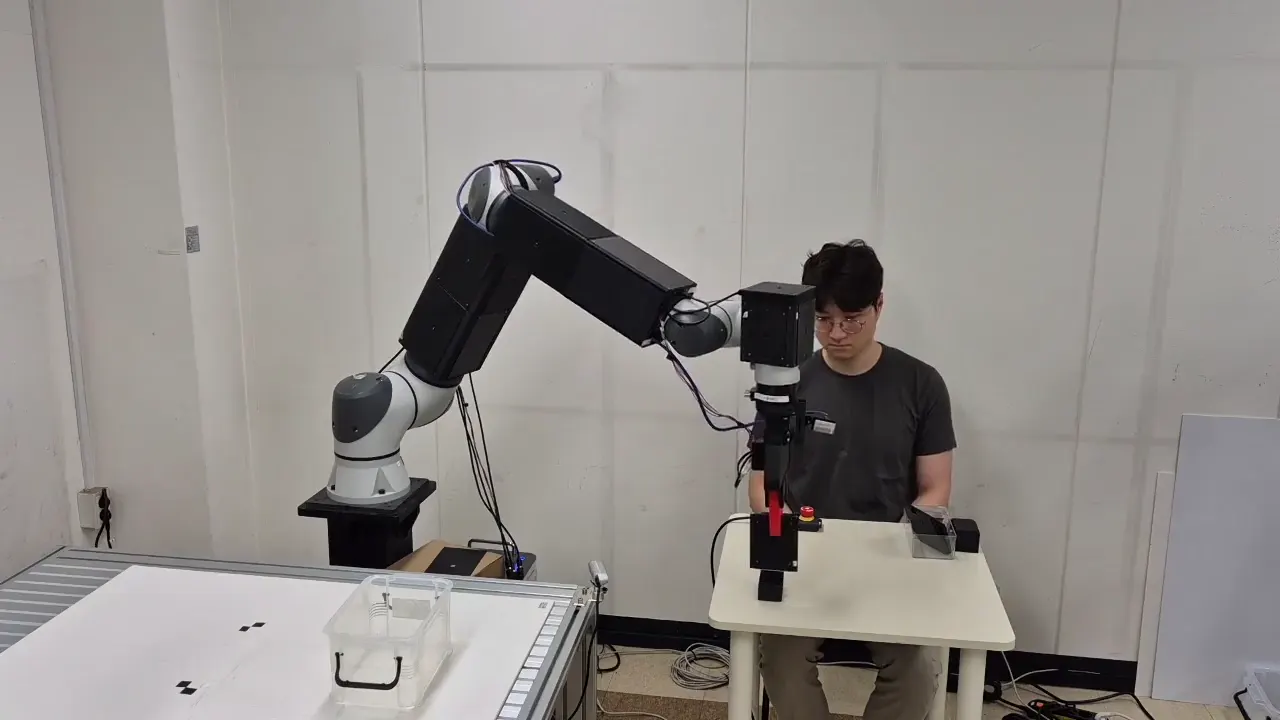
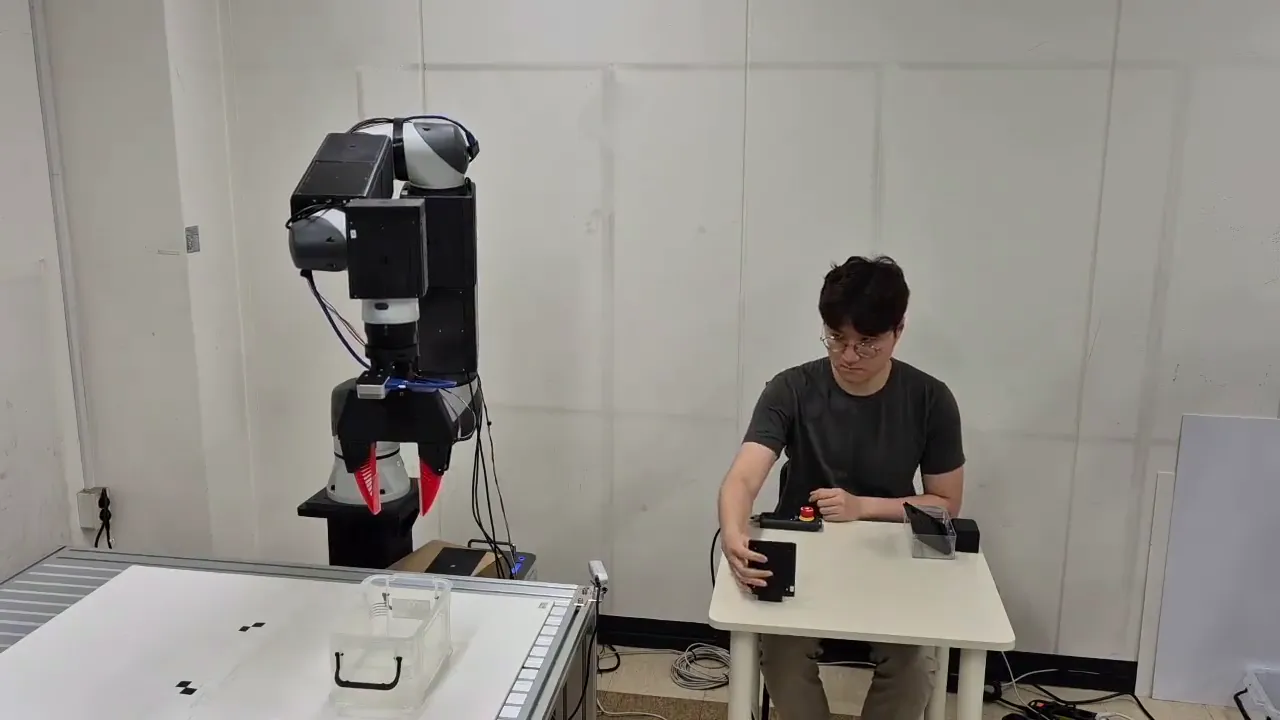
- Built the RB10 and ROS 2 evaluation pipeline for intervention and recovery trials.
- Analyzed failure modes across baseline, fine-tuning, original LPB, and the proposed method.
Team Contribution
- The broader team developed and maintained the robot platform, task setup, and safety procedures.
- Research mentors and I refined the experimental protocol and manuscript framing.
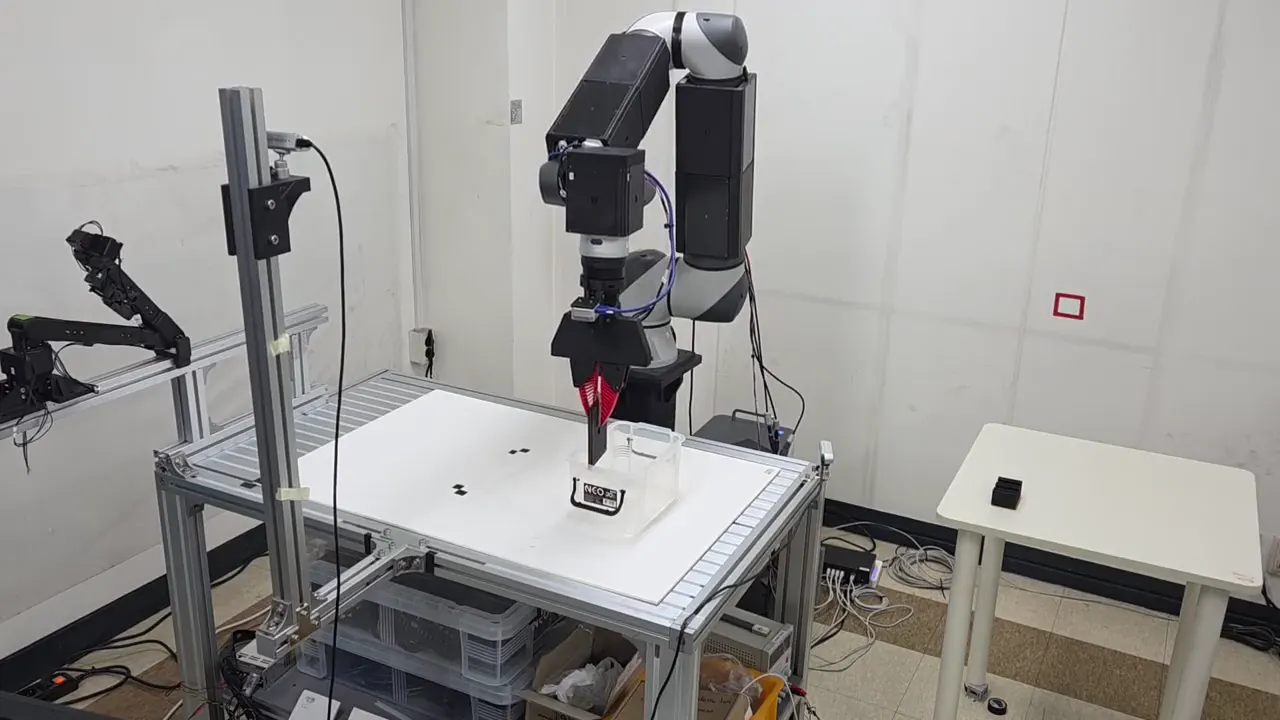
Representative experiment
Method
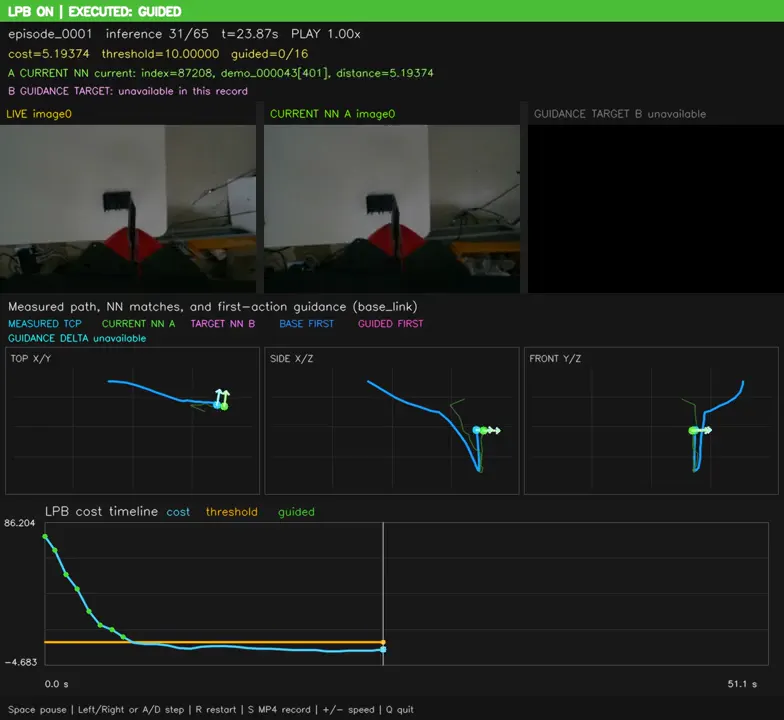
I reimplemented Latent Policy Barrier and augmented its latent-dynamics model with post-avoidance recovery transitions collected from real RMP interventions, keeping the base diffusion policy fixed. The framework combines diffusion-policy references, RMPflow reactive avoidance triggered by proximity signals, and LPB latent guidance that steers the robot back toward the demonstration distribution. An RB10 / ROS 2 pipeline synchronizes policy references, RMP-modified executions, dual-camera observations, proximity signals, and LPB internal states for every trial.
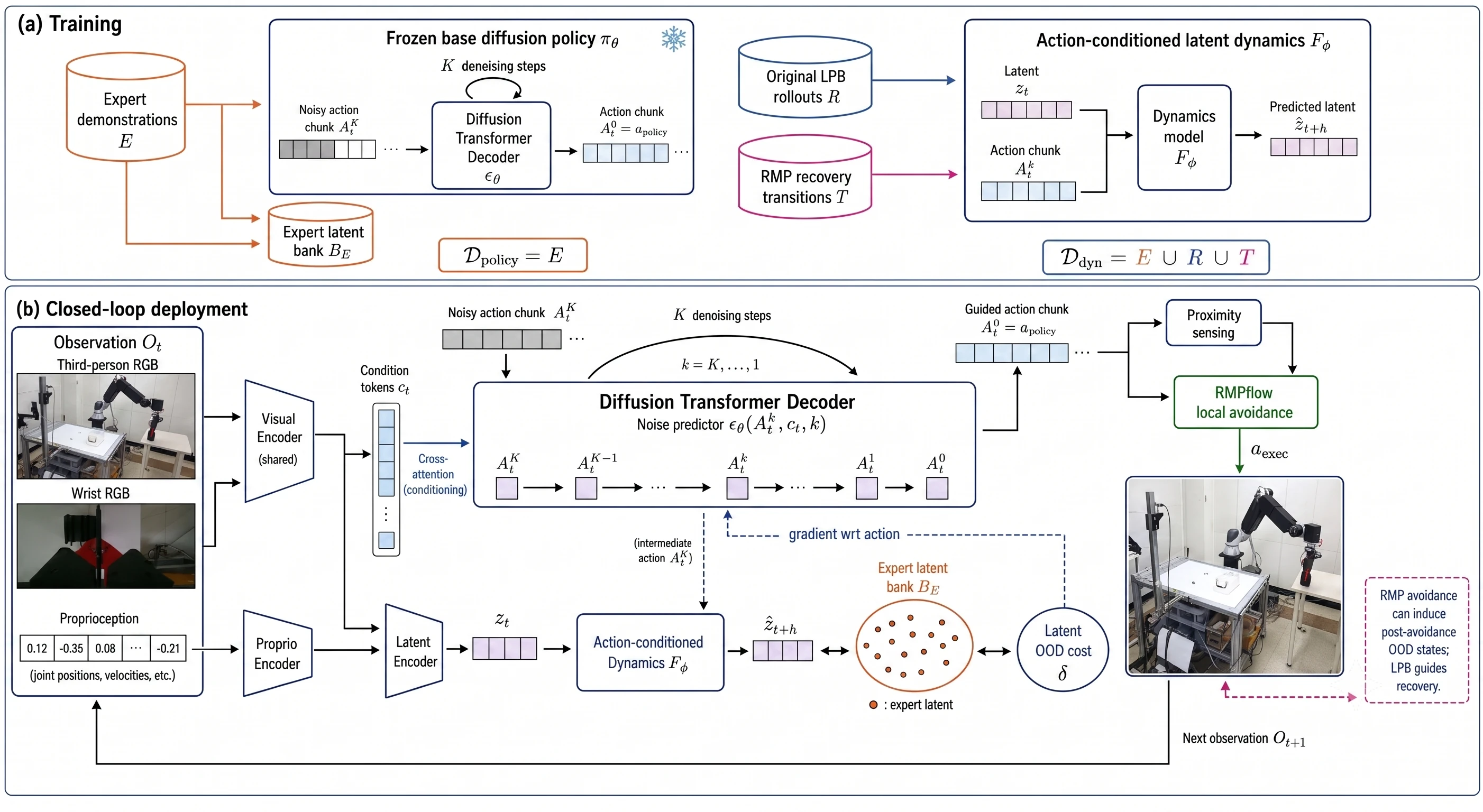
- Proximity-triggered RMP intervention
- OOD state identification
- Recovery-aware policy bridge
- Real-robot rollout evaluation
Evaluation results
| Condition | Result | Note |
|---|---|---|
| Recovery-aware LPB | 91.3% | 146 successes in 160 trials of the proposed method across eight OOD start configurations. |
| Original LPB | 64.4% | Evaluated under the same intervention setting. |
| Fine-tuning | 63.8% | Direct adaptation baseline. |
| Base policy | 25.0% | No recovery-specific adaptation. |
Across eight real-robot OOD start configurations, the recovery-aware bridge succeeded in 146 of 160 trials (91.3%). Under the same intervention setting, the recorded comparison rates were 64.4% for original LPB, 63.8% for policy fine-tuning on the same recovery demonstrations, and 25.0% for the base policy. Baseline trial counts are not stated because their denominators are not confirmed in the available records.
Experiment evidence
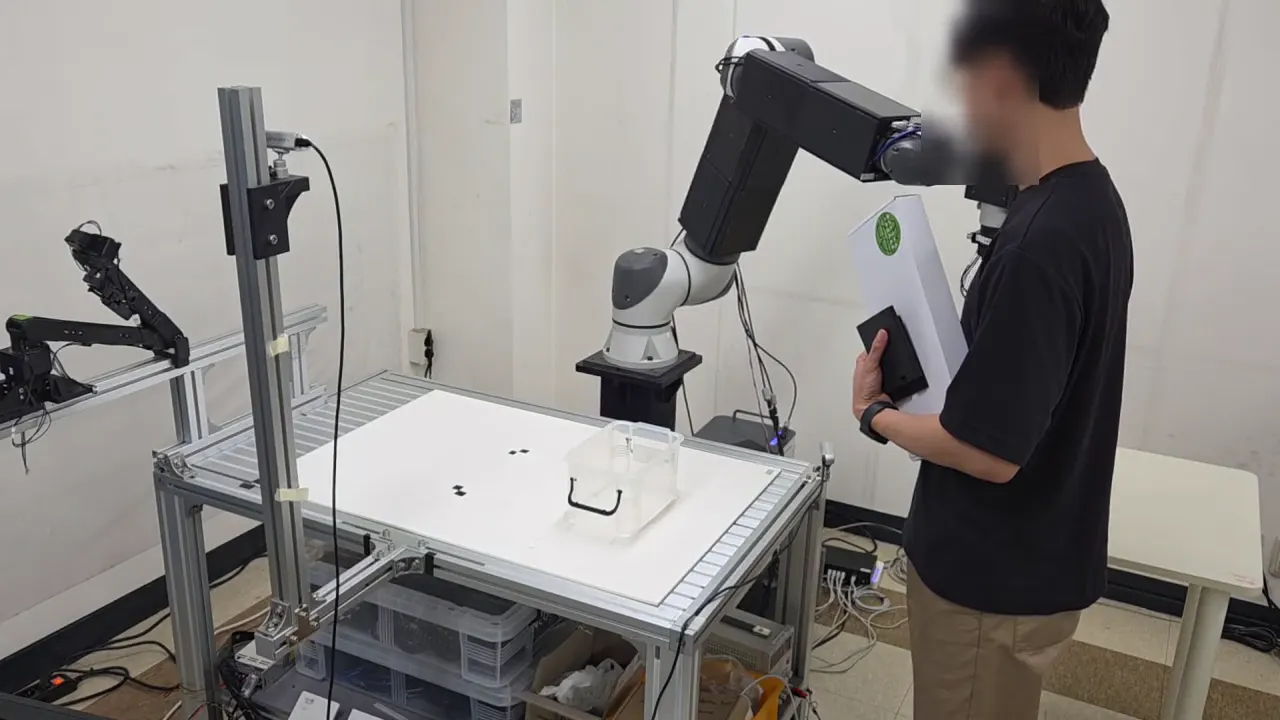
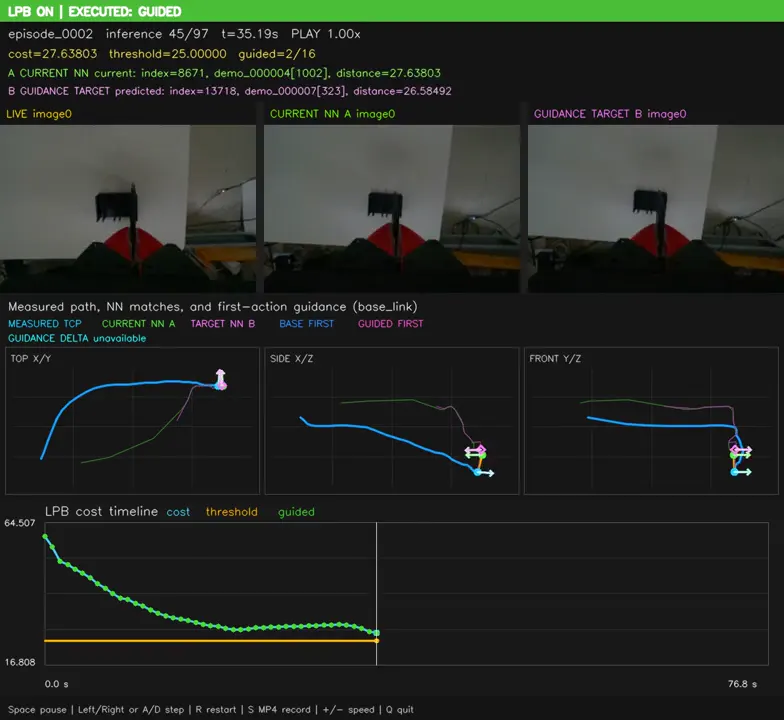
Additional experiment evidence
Limitations
- Results are specific to the evaluated task distribution and intervention protocol.
- The manuscript and broader task-suite evaluation are still in preparation.
Materials
Stack. Python, PyTorch, ROS 2, RB10, RMP, Imitation Learning.
Code and materials. Public OOD tooling fork · Request full implementation access