Recovery-Aware LPB for RMP-Induced OOD States

2026 · Manuscript in preparation

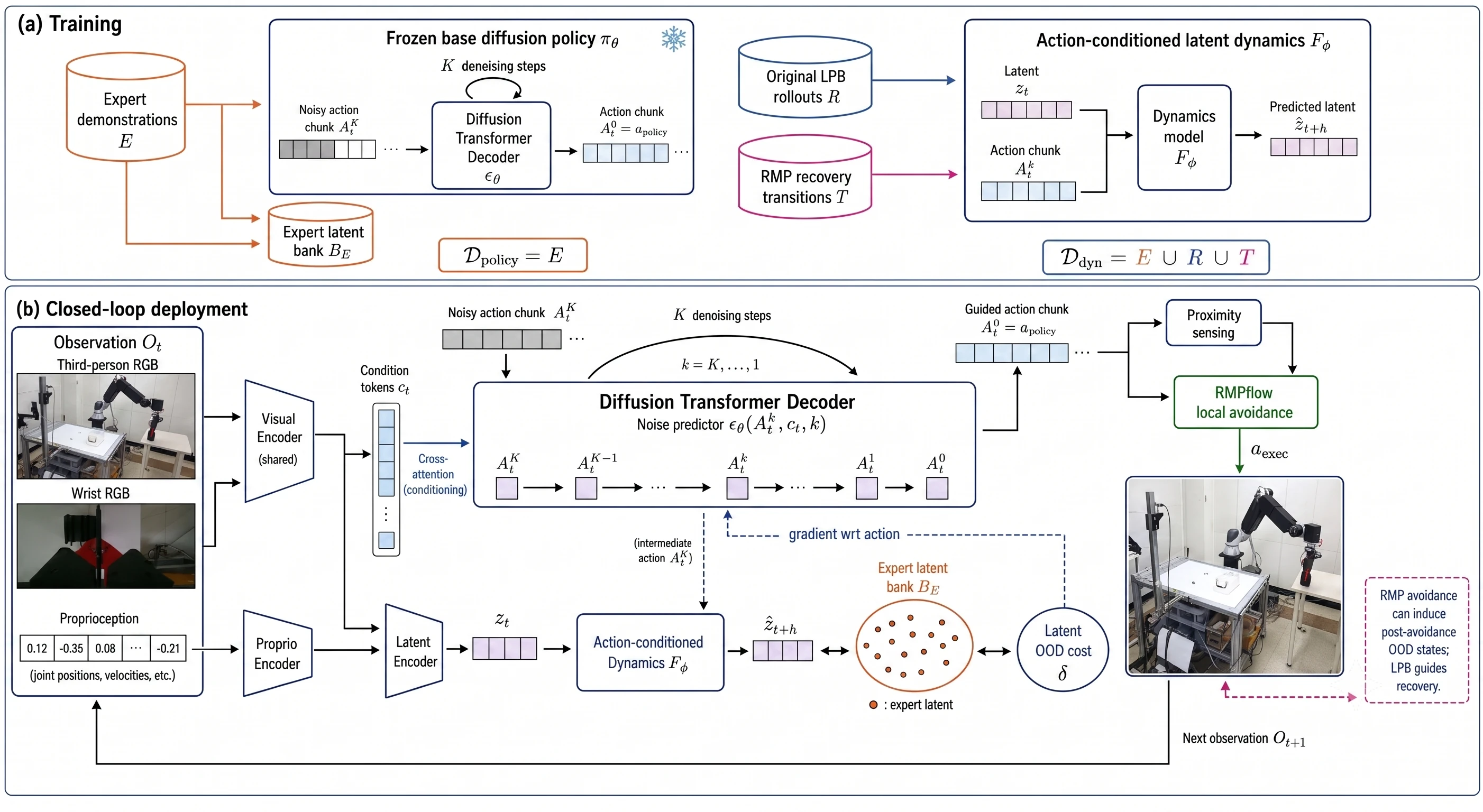
Reactive safety layers such as RMPflow keep a manipulator away from obstacles, but the avoidance motion can leave the robot in states that never appeared in the demonstrations. I designed the recovery bridge and evaluated the proposed method in 160 RB10 trials. It completed 146 trials (91.3%); the original LPB reached 64.4% under the same intervention setting.

91.3% Recovery-aware LPB. 146 successes in 160 trials of the proposed method across eight OOD start configurations.
Force-Feedback Teleoperation for Real-Robot Imitation Learning

RAGTAL / DNA-HERO Team Project

2025 · Completed

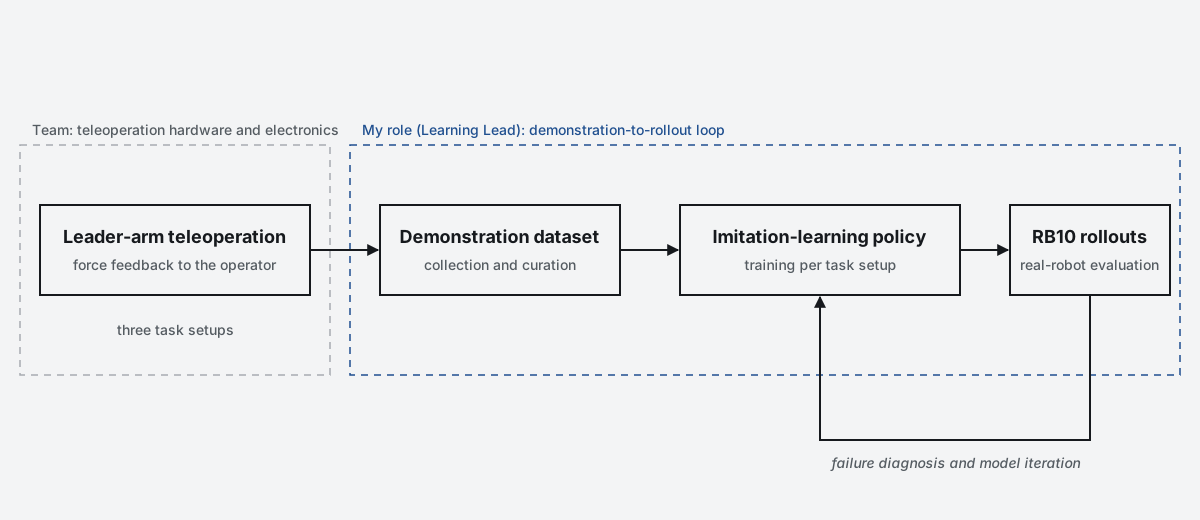
The DNA-HERO team built a custom teleoperation system with external force/torque sensing and force feedback for collecting manipulation demonstrations on an RB10. As Learning Lead, I built the demonstration-to-rollout workflow, curated the training data, and conducted 50 real-robot rollouts for each evaluated model.

9/10 Integrated final trials. Successful demonstrations during the final presentation setting.

Grounded Language-to-Motion Planning with Memory and Gripper Constraints

Extension of LMTG

2025 · Evaluated on 15 scenarios

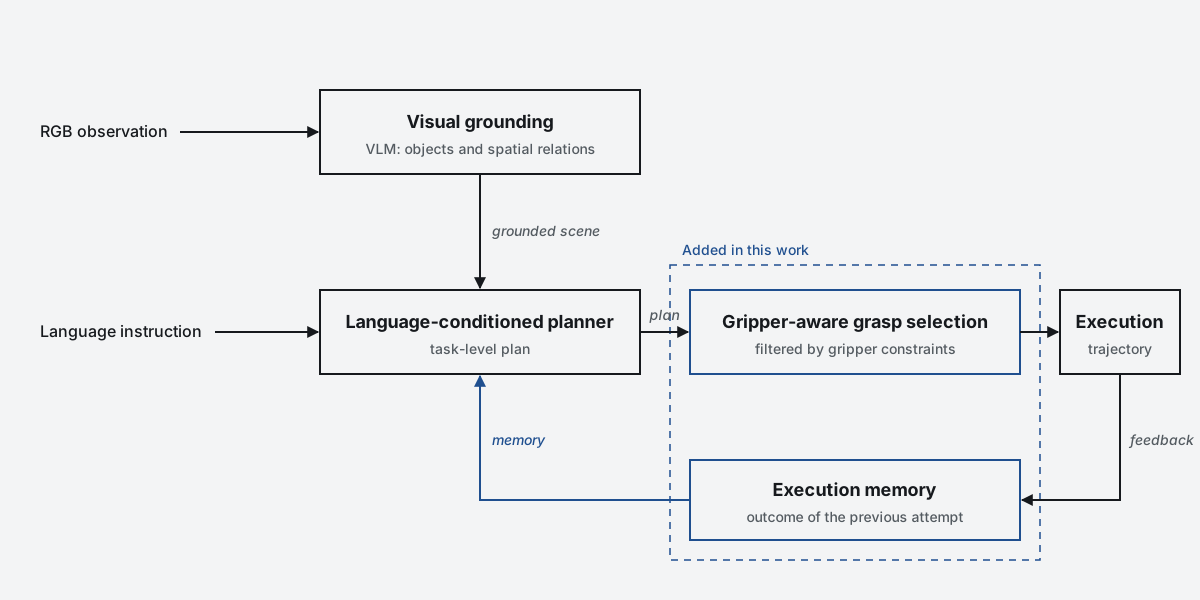
Language-model planners for tabletop manipulation often fail for reasons unrelated to reasoning: the object named in the instruction is not grounded in the image, the chosen grasp does not fit the gripper, or the same mistake is repeated after a failed attempt. I connected visual grounding and execution memory to the planner, then evaluated the system on a fixed set of 15 scenarios. Success increased from 9/15 to 12/15.

12/15 Improved system. Successes in the defined 15-scenario evaluation.

Zero-Shot Language-to-Motion Planning with Geometric Validation

Reproduction and extension of LMTG

2024–2025 · Prototype · early robot trials

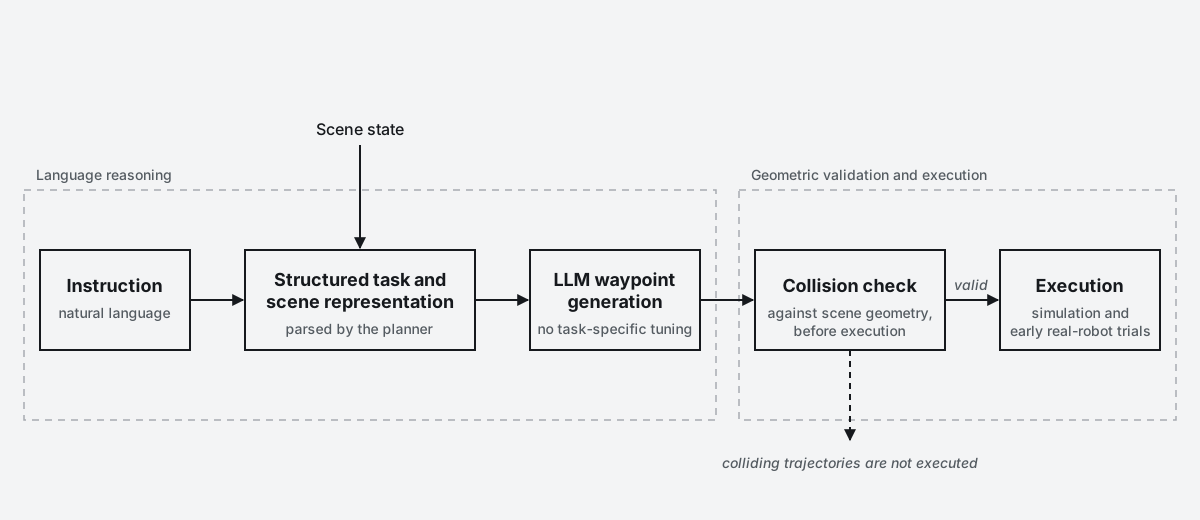
LMTG generates manipulation trajectories from natural-language instructions without task-specific training, but a language model has no geometric model of the workspace, so generated waypoints can pass through objects or approach with an unusable end-effector orientation. I implemented the task representation, waypoint parser, and collision checks, then connected the planner to simulation and initial real-robot trials.

Zero-shot Planning setting. No task-specific model fine-tuning in the prototype.